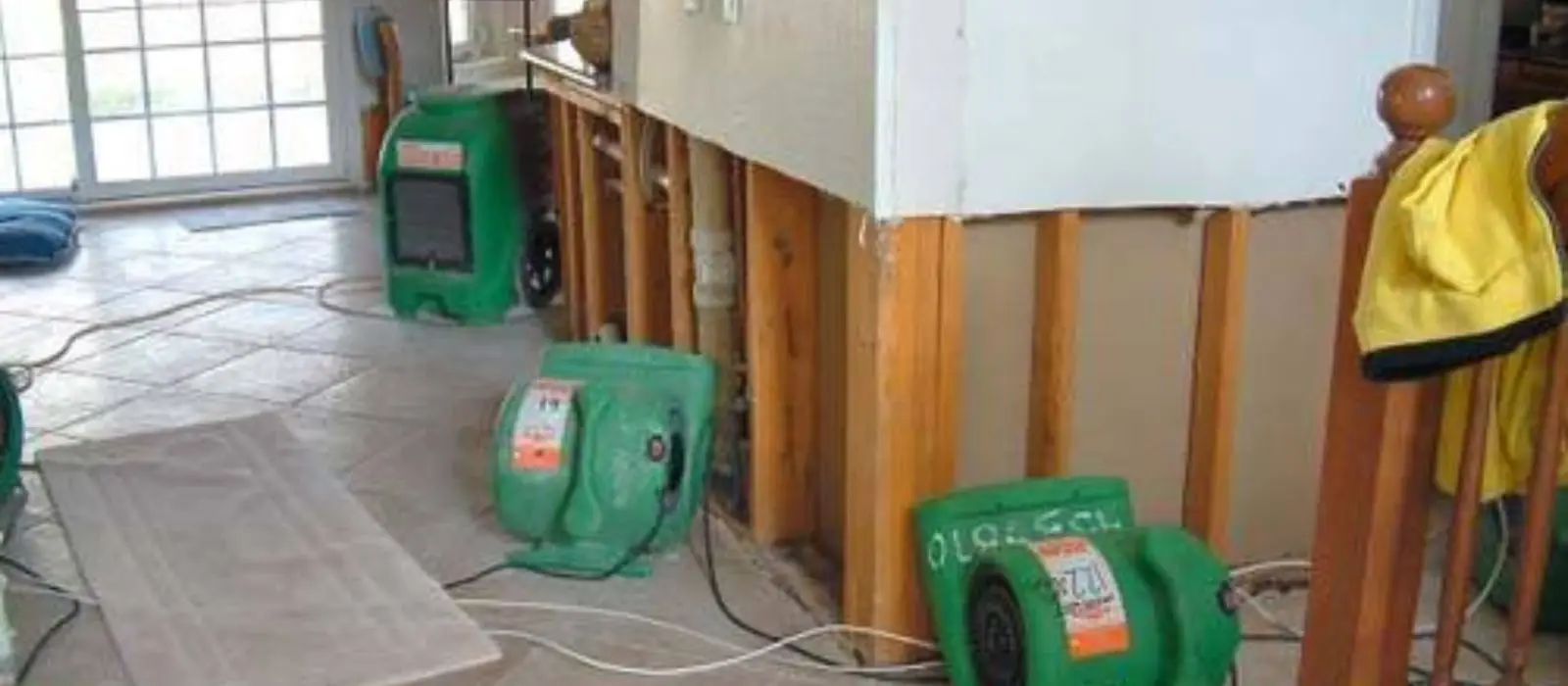
Short answer: studs often stay, drywall often goes
Solid wood studs are dense and they dry out. Drywall and batt insulation are porous and they do not tolerate much. If the water was clean and the exposure short, drywall is sometimes dried in place. If the water was contaminated, or the material sat wet for days, the drywall comes out and the studs are dried.
Whether a given wall is saved is not a judgment call made by looking. It comes down to moisture readings, the water category under S500, and how long the materials were wet.
Why drywall is the weak link
Gypsum board has a paper face and a chalky core, and both soak up water. Drywall also wicks, meaning water climbs upward from a wet baseboard line, sometimes a foot or more past what you can see. A wall can look fine at eye level and still be wet near the base.
As the paper stays damp it softens, stains and can support microbial growth. That is why crews do not trust a dry-feeling surface. They test with a moisture meter and scan with a thermal imaging camera.
The clock matters. Drywall dried quickly after a clean-water event has a fair chance. After several days, the odds fall, and removal is the safer decision.
Material by material: what is usually saved
| Material | Usually saved or removed | Why |
|---|---|---|
| Wood studs and plates | Saved | Dense wood dries to target moisture, then gets inspected. |
| Drywall, clean water, caught quickly | Often saved | Can be dried in place if readings reach target. |
| Drywall, Category 2 or 3 water | Removed | Porous material touched by contaminated water is not cleaned. |
| Drywall wet for several days | Usually removed | Paper and core have degraded, and growth risk rises. |
| Fiberglass batt insulation | Often removed | Holds water and dries slowly. Removal lets the cavity dry. |
| Painted baseboard, solid wood | Often saved | Can be removed, dried and reinstalled. |
| Particleboard cabinet backs, MDF trim | Usually removed | Swells and does not return to shape. |
| Subfloor plywood | Often saved | Dries with targeted drying, but swelling is checked. |
Category 3 water changes the rules
S500 sorts water into three categories. Category 1 is clean, Category 2 has significant contamination, and Category 3 is grossly contaminated. Sewage backup and river or surface floodwater are examples of Category 3.
Porous materials that touched Category 3 water come out. That means drywall, insulation and carpet padding. Studs get cleaned and dried instead, because wood framing can be treated and checked.
This is one reason a flooded basement wall usually gets cut open. A flood damage job and a clean supply-line leak are not handled the same way, even if the wall looks the same.
Not sure whether a wall is worth saving? Call us for an assessment and we will check it with a moisture meter.
☎ Call (385) 988-9410Flood cuts: how crews remove wet drywall
A flood cut is a horizontal cut through the drywall, made above the height the water reached or wicked. The wet lower section is removed, and the dry upper section stays on the wall.
Many crews cut a few inches above the visible line, then confirm with a moisture meter that the remaining board reads dry. If it does not, the cut goes higher. That check is why cuts are not a fixed height.
Opening the wall also lets air reach the studs and the cavity, which speeds up drying. Air movers and LGR dehumidifiers do the rest. Some jobs, including calls from Payson and Provo, call for water damage removal crews to haul out the wet material first so drying equipment can work in the open.
How wood studs are dried and judged
Wood takes in water slowly and gives it back slowly. Studs are dried with air movement and dehumidification, and moisture readings are taken each day. Drying is finished when the readings reach the target, which is usually set by comparing against dry framing in an unaffected part of the house.
Studs that stay above target get more drying time. Studs showing growth are cleaned or, in rare severe cases, replaced, and S520 practice applies when mold is involved.
Wood moves as it dries, so inspect for warping and fastener damage before closing walls. A clean, flat, dry stud is a good stud.
What gets documented
- Water category and the source of the water.
- Moisture readings for each material, each day, until target is reached.
- Photos of the affected areas before and after removal.
- The location and height of each cut.
- Equipment placed and removed, with dates.
Those records help you and your insurer see what happened. Sudden and accidental damage is often covered, so check your policy. When the walls are dry, rebuilding follows, and our repair team can close and finish them.
Spanish Fork note: river history and spring runoff
The Spanish Fork River flooded in 1983 at 2,770 cfs and again in 1984 at 3,700 cfs, against a typical spring flow of 500 to 1,000 cfs. Floodwater is treated as Category 3, so a basement wall touched by surface flooding will likely lose its drywall and insulation.
The city's floodplain map uses FEMA zones AE, AE Floodway, A and X. Look up your address at the FEMA Flood Map Service Center (msc.fema.gov) so you know your zone before the next spring.
The Utah Insurance Department notes that standard homeowners policies do not cover flood. If your walls took in floodwater, ask your insurer what applies and whether you have a separate flood policy.
Source types: city flood information page, FEMA Flood Map Service Center, Utah Insurance Department
Frequently asked questions
There is no single number, but days of saturation make removal much more likely. Clean-water exposure caught fast gives the best chance of saving it.
Rarely. Solid framing is dried to target and inspected. Replacement is for structural damage or severe decay.
Fans move air but do not remove moisture from the cavity. Pros use air movers with LGR dehumidifiers and take daily moisture readings.
It means wet material is removed and the cavity is opened so it can dry. The cut is above the wet line, confirmed by a moisture meter.
Yes. Category 3 water means porous materials come out, and studs are cleaned and dried instead.
Report street flooding or clogged storm drains to Spanish Fork Public Works. If water has entered your home, call a restoration crew as well.